

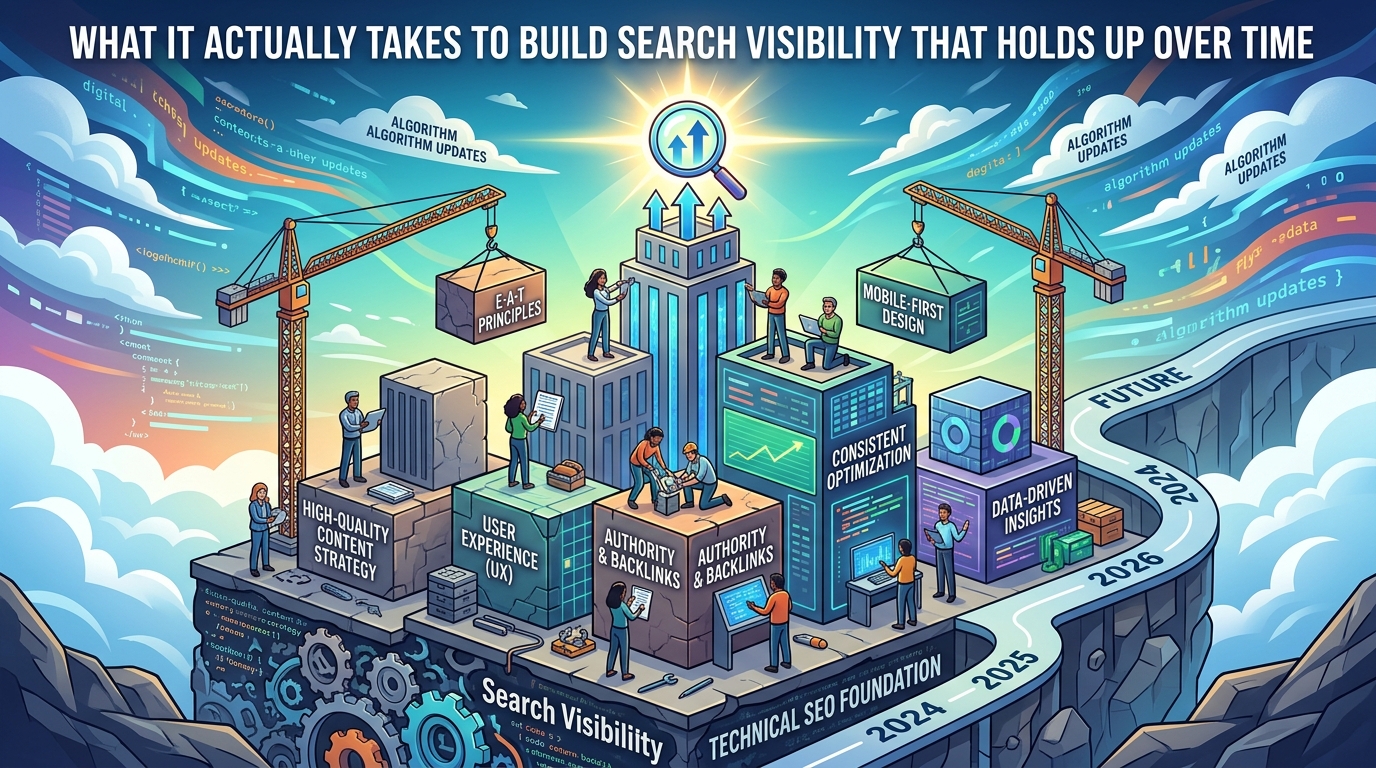
Most companies that have tried to improve their search visibility and been disappointed made the same mistake — they invested in activity rather than outcomes. Understanding what drives lasting search visibility, and how to evaluate whether the work being done is actually moving toward that goal, changes both what gets invested in and what it produces.
Why Search Visibility Is Worth Building Deliberately
The Intent Behind Search Traffic
Search traffic is different from most other forms of digital traffic because of the intent that drives it. Someone who types a specific service query into a search engine is expressing active interest in finding a provider — they’re not browsing casually or consuming content for entertainment. Showing up prominently for that query, with a website and profile that answers their questions and makes contact straightforward, converts that intent into customer acquisition at a rate that other traffic sources rarely match.
That intent-based connection between search visibility and customer acquisition is what makes search optimization one of the more durable marketing investments available to companies competing in local and regional markets. The rankings built through consistent, well-directed effort continue producing customer contact long after the work that created them was completed.
The Compounding Nature of Search Investment
Search visibility compounds over time in ways that most other marketing doesn’t. Content that ranks well continues attracting visitors without ongoing cost per visit. Authority built through consistent external signal accumulation makes the site more competitive for additional queries over time. A Google Business Profile managed consistently develops a review profile and completeness level that compounds its local ranking strength month over month.
The flip side is that search visibility built on a weak foundation — thin content, inconsistent signals, or tactics that search engines are designed to discount — erodes in ways that are expensive to recover from. Building visibility on a foundation that holds up under algorithm updates and competitive pressure is worth the additional effort it requires over approaches that produce quick but fragile results.
The Three Pillars of Lasting Search Visibility
Technical Health
A website that search engines can’t read correctly, that loads slowly on mobile devices, or that has structural issues preventing pages from being indexed can’t rank regardless of how good its content is or how many external signals point to it. Technical health is the prerequisite — the foundation everything else is built on.
Technical problems range from ranking-consequential to negligible, and the distinction matters for how resources are allocated. Crawl errors blocking entire page categories from being indexed are consequential. Minor schema markup warnings with no measurable ranking impact are not. Effective technical work addresses the issues that affect performance materially rather than treating every technical recommendation as equally urgent.
Content That Serves Both Search Engines and Readers
Pages that clearly communicate a specific topic for a specific audience, that answer the questions a potential customer has before making contact, and that are organized in a way search engines can parse accurately perform better in search results — and convert better when they get there — than pages optimized primarily for search engines rather than the people who will actually read them.
The content that produces the best long-term search results isn’t produced primarily for search engines — it’s produced for the people searching for it, in a way that happens to send the signals search engines use to assess relevance and quality. The overlap between content that’s genuinely useful to a reader and content that ranks well for the right queries is larger than most companies realize, and it’s where effective content strategy operates.
External Authority Signals
Rankings in competitive searches are determined not just by what’s on a website but by what the broader web signals about that site’s credibility and relevance. Links from credible and topically relevant websites, consistent business information across directories, and mentions in relevant publications all contribute to the authority profile that search engines use to differentiate between sites with comparable on-page fundamentals.
Authority signals accumulate gradually — they can’t be manufactured quickly without using approaches that carry long-term risk — and they’re what determines ranking position when content quality and technical health are comparable across competing sites. Investing in authority building consistently over time is what produces ranking strength that holds up under competitive pressure.
What the Work Actually Involves
Starting With an Honest Assessment
Work that produces results begins with understanding the current state before recommending any course of action. That means reviewing existing rankings, traffic sources, technical health, content quality, Google Business Profile performance, citation consistency, and the competitive landscape for the queries that matter most to customer acquisition.
The assessment produces a prioritized picture of what’s limiting current visibility and what addressing those limitations would realistically produce — in what timeframe, at what level of effort, and with what degree of confidence given the specific competitive conditions. A proposal that follows an honest assessment is traceable back to specific findings. A proposal that doesn’t follow an assessment is a generic scope applied regardless of what the situation actually calls for.
Prioritization That Reflects the Competitive Environment
Effective search optimization directs effort at the factors that will produce the most meaningful results given the specific competitive environment — not at a standard checklist applied uniformly regardless of starting conditions. A company with significant technical issues and thin content needs different work than one with solid technical health and strong content but limited external authority. Getting that prioritization right is what makes optimization work efficient rather than comprehensive in ways that don’t move rankings.
Execution That Connects to Outcomes
The work that produces ranking improvements is specific — particular pages improved in particular ways, particular authority signals built through particular approaches, particular technical issues resolved in a particular order. Providers who can describe their work at that level of specificity are doing work that can be evaluated and improved. Those who describe their approach in general terms or proprietary methodology language are either doing generic work or obscuring work that wouldn’t withstand scrutiny.
What Realistic Timelines Look Like
The Factors That Affect Timeline
The time it takes for search optimization work to produce measurable ranking improvements depends on the current state of the site, the competitiveness of the target queries, and the consistency of the work being applied. Technical fixes on a site with clear structural issues can produce improvements within weeks. Content improvements for lower-competition queries can show ranking impact within one to two months. Authority building for competitive queries produces results over six to twelve months as external signals accumulate to the threshold where search engines treat them as credible.
Providers who promise dramatic results in thirty days for competitive queries are misrepresenting the timeline or planning to use approaches that produce short-term signals at the cost of long-term stability. Understanding realistic timelines before committing to an engagement produces better decisions about what to invest in and more accurate evaluation of whether progress is on track.
What Progress Looks Like Before Rankings Move
One of the more frustrating aspects of search optimization work is that progress often isn’t visible in rankings until signals have accumulated past a threshold that produces measurable change. The work done in months one through four may produce little visible ranking movement and then produce significant ranking improvements in months five and six as accumulated signals cross that threshold.
Measuring leading indicators — technical issues resolved, content gaps filled, external signals acquired, citation inconsistencies corrected — provides a more accurate picture of whether the work is on track during periods when ranking movement hasn’t yet materialized.
Common Mistakes That Limit Results
Targeting the Wrong Queries
Optimization directed at broad, high-competition queries dominated by national directories and major brands produces no meaningful results for most local and regional companies. The queries that drive customer acquisition are specific — service terms combined with location modifiers, problem-specific language, and the questions potential customers ask before making a hiring decision. Targeting those queries rather than the most obvious and competitive ones is where effective optimization starts.
Inconsistent Effort Over Time
Search visibility built through consistent effort erodes when that effort stops. Companies that invest in optimization for a few months, see early improvements, and then pause typically see those improvements erode within six to twelve months as competitors continue building their presence and search algorithms update their assessment of relative authority. Treating optimization as an ongoing management responsibility rather than a project with a completion date is what produces visibility that holds up rather than fades.
Evaluating the Wrong Metrics
Reports that emphasize domain authority scores, total keywords tracked, or backlink database counts are presenting metrics that are correlated with results under ideal conditions but disconnected from the customer acquisition outcomes that justify the investment. Rankings for queries with genuine buying intent, organic traffic from those rankings, and contact activity produced by that traffic are the metrics that actually matter — everything else is context.
Choosing the Right Provider
What Effective Providers Do Differently
Providers who produce consistent results approach each engagement with a genuine assessment of the specific situation before recommending work, explain what they’re doing and why in terms specific enough to be evaluated, set realistic expectations about timeline and outcomes, and report on metrics that connect to customer acquisition rather than activity volume.
The questions that reveal how a provider actually works are specific enough that the answers distinguish systematic approaches from generic ones: What will you do in the first sixty days and why? How do you determine which queries to prioritize? What does reporting cover and how does it connect to customer acquisition? What’s your process when rankings don’t move after three months of work?
Local Market Knowledge
For companies investing in search engine optimization in Utah, the right provider understands the specific competitive dynamics of local markets in the state — what ranking in specific categories and geographies actually requires, how local search behaves differently from broader competition, and what the realistic path to meaningful visibility looks like given the specific queries and competitors involved. Local specificity produces recommendations calibrated to actual conditions rather than a national framework applied to a local problem.
Conclusion
Search visibility built on a solid foundation — technically sound, content-driven, and supported by legitimate authority signals accumulated over time — produces customer acquisition outcomes that compound in value as rankings hold up under competitive pressure and algorithm updates.