

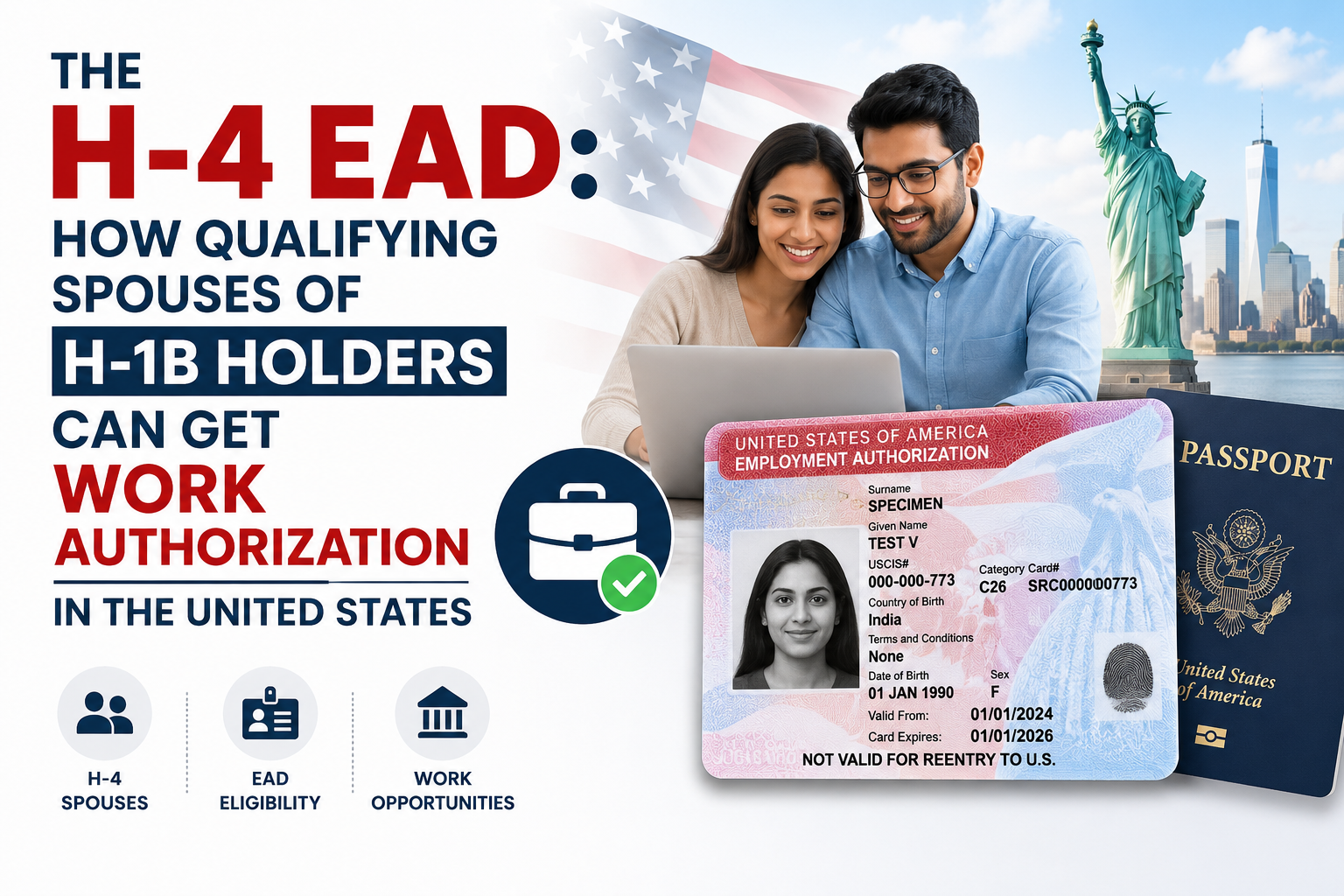
For spouses of H-1B visa holders, the ability to work in the United States is not automatic. It requires a separate application and approval — and recent policy changes have made the timing of that process more consequential than it has been in the past. The H-4 EAD, an Employment Authorization Document available to qualifying H-4 visa holders, provides work authorization with no restrictions on employer, industry, or schedule. Understanding who qualifies, how to apply, and what the current processing landscape looks like is essential for anyone in this situation.
What the H-4 EAD is
The H-4 EAD is a work permit issued by U.S. Citizenship and Immigration Services (USCIS) to eligible spouses of H-1B visa holders. By default, H-4 visa holders — who accompany H-1B workers as dependents — are not authorized to work in the United States. The EAD changes that, granting the holder full work authorization with no restrictions on employers, roles, industries, or work schedule. H-4 EAD holders may work full-time, part-time, on a contract basis, or as self-employed individuals, and may change employers freely without notifying USCIS.
Unlike the H-1B visa itself, the H-4 EAD does not require an employer sponsor or a Labor Condition Application — making it a significantly more flexible form of work authorization.
Who qualifies
Eligibility for the H-4 EAD depends on conditions that must be met by both the H-4 spouse and the H-1B visa holder.
The spouse applying for the EAD must be in valid H-4 status at the time of filing and must be physically present in the United States. Filing from abroad is not permitted.
The H-1B visa holder must satisfy at least one of the following:
- An approved Form I-140, Immigrant Petition for Alien Workers, confirming that the H-1B holder has an immigrant petition on file and is on a path toward a Green Card
- An approved H-1B extension beyond the standard six-year cap under sections 106(a) and (b) of the American Competitiveness in the Twenty-First Century Act (AC21), which applies when the H-1B holder has been in that status for more than six years and their Green Card application has been pending for at least 365 days
Only one of these conditions needs to be met.
How to apply
The H-4 EAD is obtained by filing Form I-765, Application for Employment Authorization, with USCIS. The process involves the following steps:
- Gather supporting documentation. This typically includes proof of the H-1B holder’s approved Form I-140 or AC21 extension, the H-4 spouse’s most recent Form I-94 Arrival/Departure Record, and documentation of the marital relationship such as a marriage certificate.
- Complete and file Form I-765. The form should be downloaded from the USCIS website to ensure the most current version is used. It may be filed online or by mail.
- Pay the filing fee. As of current USCIS guidance, the filing fee is $470 for online submissions and $520 for paper filings. Applicants should verify current fees on the USCIS filing fees page before submitting.
- Include two passport-style photographs meeting USCIS specifications — 2 inches by 2 inches, plain white or off-white background, neutral expression, clear and in color.
After USCIS accepts the application, a receipt notice is issued. Case progress can then be tracked through the USCIS online portal.
Processing times and the renewal deadline
As of June 2026, USCIS processing times for H-4 EAD applications range from approximately six to 13.5 months, depending on individual case circumstances. Given this range, filing as early as possible is strongly advisable.
This is particularly important in light of a significant policy change that took effect on October 30, 2025: USCIS no longer grants automatic extensions of H-4 EAD work authorization for holders who file renewal applications. Previously, a timely-filed renewal allowed holders to continue working for up to 540 days while their application was pending. Under current policy, the EAD expiration date is firm — if a renewal is not approved before the existing EAD expires, the holder must stop working until the new card arrives.
USCIS allows renewal applications to be filed up to 180 days before the current EAD expires. Given current processing times of six to 13.5 months as of June 2026, filing at the 180-day mark — or earlier if possible — is the most effective way to reduce the risk of a gap in work authorization.
Validity and renewals
The H-4 EAD is generally valid for the same period as the H-1B holder’s current status, typically up to three years. There is no limit on the number of times it may be renewed, provided the holder continues to meet all eligibility requirements and the H-1B spouse maintains qualifying status. Keeping track of both the EAD expiration date and the H-1B spouse’s status expiration date is essential for planning renewals without disruption.
When professional support makes a difference
The H-4 EAD involves eligibility conditions tied to the H-1B holder’s immigration status, documentation requirements, and renewal deadlines that now carry greater urgency given the end of automatic extensions. For H-4 spouses who want to ensure their application is filed correctly, renewals are managed proactively, and any changes in the H-1B holder’s status are properly accounted for, working with experienced immigration counsel is a practice frequently associated with fewer complications and greater continuity of work authorization.
 Mudsr
Mudsr