

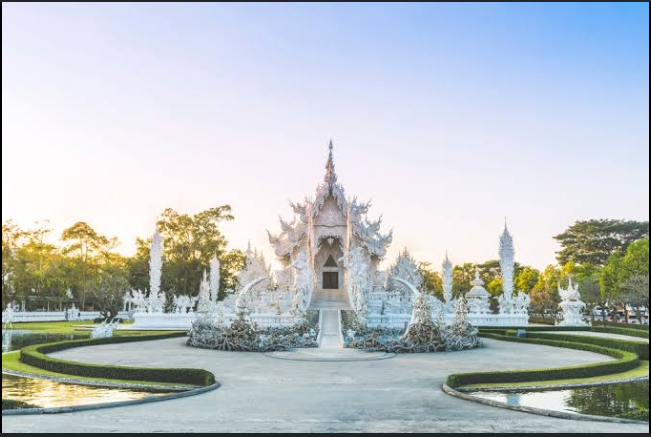
Travel has a strange habit of teaching people to collect moments while sometimes forgetting how to receive them. That is especially true in sacred places. A mountain shrine, a ceremonial forest, a desert spring, or a stone complex may appear on an itinerary beside beaches, markets, and famous viewpoints, but it does not belong in the same mental category as a casual stop for photos. Sacred places ask more from visitors than curiosity. They ask for restraint, context, and humility.
This matters whether someone is planning a pilgrimage, a cultural trip, or even browsing Galapagos Islands vacation packages and imagining a journey built around wonder. Beautiful destinations often hold layers that are not obvious at first glance. A place can be ecologically stunning and spiritually alive at the same time. It can welcome visitors and still not exist for their entertainment. That distinction changes everything about how we move through it.
Too often, sacred places are treated like scenery with a backstory. A guide mentions a legend, a sign explains a ritual, a few photos are taken, and everyone moves on. But for the people connected to that place, the meaning is not decorative. It is active. Ceremonies are still held. Ancestors are still honored. Rules are still observed. The land is still understood as a relative, a teacher, or a source of obligation. When visitors reduce that living relationship to an interesting cultural detail, they miss the deepest reality of the site.
A Sacred Place Is Part of a Living Relationship
One of the biggest misunderstandings in tourism is the idea that importance can be measured by popularity. Sacred places do not become meaningful because many people visit them. Their value comes from long standing relationships between communities, memory, belief, and land. In many traditions, the place is not just where spirituality happens. The place itself participates in it.
That can be hard for modern travelers to absorb because tourism often trains us to consume places quickly. We are encouraged to see more, cover more ground, and turn each stop into content. Sacred places resist that rhythm. They are not experiences to complete. They are relationships already in progress, and visitors are stepping into them briefly.
This is why access alone is not the same as permission. A trail may be open. A monument may be public. A lookout may be famous. Yet there can still be cultural boundaries about where to stand, what to photograph, what to say, and when to remain silent. The U.S. National Park Service notes that places within public landscapes may still be sacred to living peoples, which is an important reminder that public visibility does not erase spiritual significance. Guidance for visiting Indigenous landscapes respectfully offers a useful model for understanding that difference.
When Respect Is Missing, Damage Is Not Just Symbolic
People often think disrespect in sacred places is mainly about bad manners. It is much more than that. Noise can interrupt ceremonies. Foot traffic can wear down fragile ground. Unauthorized photography can turn intimate spiritual practices into spectacle. Souvenir hunting can become theft. Even seemingly harmless behavior, like climbing, touching, or wandering off path, can violate rules that carry serious meaning for local communities.
There is also a quieter kind of harm that happens when sacred places are packaged too neatly for visitors. Once a site is marketed only as a must see attraction, its cultural complexity gets flattened. The living custodians of the place can disappear behind branding. Ritual becomes performance. Reverence becomes ambience. What remains is a version of the site that feels accessible to outsiders but increasingly alien to the people whose identity is tied to it.
That process is not just emotional. It can affect decision making about land use, conservation, and visitor management. If sacred places are framed only as tourism assets, then the priorities around them can shift toward convenience and revenue instead of continuity and care. That is a dangerous trade.
Spiritual Meaning and Ecological Health Are Often Linked
A sacred place is rarely only sacred in the abstract. It is usually connected to water, animals, seasons, plants, migration routes, burial grounds, or ceremonial cycles. In many cultures, spiritual protection and ecological protection are intertwined. This is one reason sacred natural sites have long served as reservoirs of both biodiversity and cultural memory. The International Union for Conservation of Nature has emphasized that sacred natural sites are among the oldest forms of protected areas and are often important for both biological and cultural preservation. Their overview of sacred natural sites and conservation helps make that connection clear.
This perspective can reshape how travelers think about environmental care. Staying on paths, following local rules, and honoring closures are not only acts of outdoor etiquette. They can also be acts of cultural respect. In a sacred landscape, ecology is not just habitat. It may be part of ceremony, identity, and law.
That idea is especially important in destinations where tourism is built around natural beauty. Visitors may admire wildlife, dramatic geology, or remote scenery without realizing that these are not separate from human meaning. The Western habit of splitting nature from culture does not always apply. In many sacred places, that division simply does not exist.
Good Visitors Learn to Accept Limits
Modern travel culture often celebrates access, personalization, and freedom. But sacred places sometimes require the opposite. You may not be able to go everywhere. You may not be allowed to photograph what you see. You may need to visit with a guide, avoid certain dates, or keep distance from ceremonies. These limits are not failures of hospitality. They are expressions of stewardship.
Accepting limits can feel unfamiliar, especially for travelers used to treating every destination as fully available once the ticket is paid for. Yet limits can be a gift. They remind us that not everything meaningful is ours to capture. Some experiences are valuable precisely because they cannot be possessed.
This is where travel becomes more ethical and, honestly, more memorable. When people stop trying to extract the maximum possible access from a place, they begin to notice different things. They listen more carefully. They move more slowly. They pay attention to what local communities are actually saying rather than what marketing language promises.
Visiting Sacred Places Without Reducing Them
Respect begins before arrival. Learn whose place you are visiting. Read beyond the standard tourism summary. Understand whether the site is archaeological, ceremonial, inhabited, protected, or all of those at once. If local authorities or community leaders ask visitors not to do something, take that seriously the first time.
Once there, act like a guest, not an owner. Keep voices low. Follow posted rules. Do not remove anything. Ask before photographing people, rituals, or sensitive areas. Resist the urge to turn every meaningful moment into content. If access is restricted, do not search for workarounds. And if interpretation is offered by local voices, pay attention. They are not adding flavor to the experience. They are giving the experience its shape.
The best travel does not only show us new places. It teaches us new forms of attention. Sacred places are powerful because they interrupt the habit of consumption and replace it with responsibility. They remind us that some landscapes are held together by prayer, memory, obligation, and care, not just by maps and ticket sales.
In the end, sacred places are not less welcoming because they ask for reverence. They are more generous. They offer a chance to encounter a world that is not organized around the visitor. That can be uncomfortable at first, but it is also deeply valuable. A traveler who understands that leaves with something better than a checklist. They leave with a changed sense of how to stand in someone else’s meaningful world.
 admin
admin