

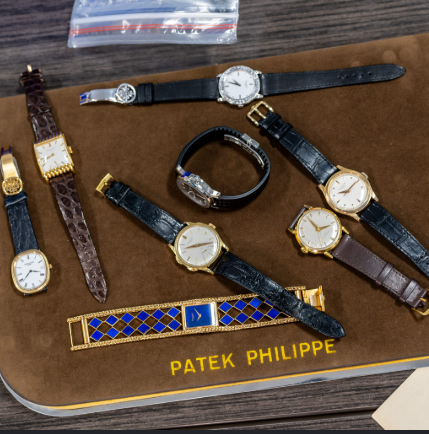
Newcomers to the brand tend to arrive knowing two things: that the Nautilus exists, and that it is difficult to get. Both are true, and both obscure a catalogue that is considerably broader and, in several directions, considerably more interesting.
The house has been operating from Geneva since 1839, and its lines were not designed as tiers of a single product. They were developed to do different things: to sit under a cuff, to survive a swim, to track a calendar without correction for a century, to strike the hours on demand. Understanding what each line is actually for makes the decision far easier than comparing them by desirability alone.
Calatrava
Introduced in 1932 and named after the Calatrava cross the house uses as its emblem, this is the reference point for the round dress watch, and arguably the design against which the entire category is measured.
The proposition is restraint. A clean round case, a legible dial, minimal ornament, proportions that sit flat under a shirt cuff. Variations across the decades have included officer’s cases with hinged backs, hobnail bezels, small seconds and centre seconds layouts, and a range of dial treatments, but the underlying idea has not moved.
It suits someone who wants the watch to be quiet. In a room where sport models are doing the talking, a Calatrava is the piece other collectors notice, which is a particular kind of appeal and not one everyone is looking for.
Nautilus
Launched in 1976 and designed by Gérald Genta, the Nautilus brought the house into luxury sports watches with a case shape drawn from a ship’s porthole, a horizontally embossed dial, and an integrated bracelet that flows from the case rather than attaching to it.
Its cultural position now exceeds its original brief by a wide margin. What was conceived as a steel sports watch has become the most requested design the house produces, and demand has remained intense across steel and precious metal references alike, and across time-only, moonphase, chronograph, and travel time variants.
The practical consequence is that anyone who wants one is operating in a market where availability, not preference, is usually the constraint.
Aquanaut
Introduced in 1997, the Aquanaut took the integrated sports concept in a more contemporary direction: a rounded octagonal case, a dial with an embossed pattern of its own, and a composite strap that made it more casual than anything else in the catalogue at the time.
It reads younger and wears more informally than the Nautilus, and it has developed a following that is not simply people who could not obtain the older design. The line has expanded well beyond time-only, including chronograph, travel time, and annual calendar execution, plus a women’s line with its own treatment.
For someone who wants a watch that can go from an office to a boat without ceremony, this is frequently the more sensible answer.
Complications
This is where the catalogue stops being about design language and starts being about mechanics. The Complications line covers watches that do something beyond telling the time: annual calendars that require adjustment only once a year, world time watches that display every time zone simultaneously, travel time models with a second hour hand for a home reference, moonphase displays, and power reserve indications.
The annual calendar in particular deserves attention from anyone building a first serious collection. It is a genuinely useful complication, developed by the house, and it lives comfortably in daily wear in a way the more elaborate calendars do not.
World time models with enamel dials sit in a different category again, closer to decorative art with a mechanism attached.
Grand Complications
The top of the catalogue, where multiple complex mechanisms combine in a single watch: perpetual calendars that account for varying month lengths and leap years, split-seconds chronographs, minute repeaters that chime the time on demand, celestial displays that map the night sky.
Two things are worth knowing here. First, these are the pieces that define the house’s technical reputation, and the minute repeater in particular is a discipline where very few manufacturers operate credibly. Second, and less widely understood, desirability within this category varies enormously. Some grand complications trade well below their retail positioning on the secondary market, which makes them one of the few places in the brand where a buyer can acquire extraordinary mechanics without competing against sport model demand.
That gap between technical significance and market price is the most interesting arbitrage in the catalogue for a collector who genuinely cares about movements.
The Rest of the Catalogue
Several lines get overlooked and should not be.
- Golden Ellipse, introduced in 1968, built on a case shape derived from classical proportion. Unmistakable and entirely unlike anything else the house makes.
- Gondolo, drawing on the rectangular and shaped cases of the early twentieth century, for someone who finds round cases predictable.
- Twenty~4, launched in 1999 as a women’s line, later expanded with a round automatic execution alongside the original rectangular quartz design.
- Cubitus, introduced in 2024 as the first genuinely new line in decades, taking the integrated sports approach into a squared case.
These lines carry the same standards of construction and finishing as the ones with waiting lists. What they lack is the demand pressure, which for a buyer more interested in the watch than the queue is an advantage rather than a drawback.
Choosing Between Them
The useful question is not which line is best but how the watch will actually be worn.
Someone who wears tailoring regularly and wants one watch is served better by a Calatrava than by a sports model bought for its reputation. Someone who lives in casual clothing and wants a piece for daily wear should be looking at the Aquanaut before the dress lines. Someone who travels constantly should look at travel time and world time before anything else, because a complication that solves an actual problem gets worn far more than one that impresses.
Case size and proportion matter more than specifications suggest, and the only reliable way to resolve them is on the wrist. Trying pieces in person, even ones not being considered, calibrates the eye quickly.
Access is its own consideration, and for the most requested references the secondary market is where availability actually exists. An authentic patek philippe collection is offered by Wrist Aficionado spanning Nautilus, Aquanaut, Calatrava, Complications, Grand Complications, Cubitus, Golden Ellipse, Gondolo and Twenty~4, with each piece authenticated and available to view at their boutiques in New York, Miami Beach, and Beverly Hills or shipped worldwide. Wherever a buyer sources from, seeing several lines side by side does more to settle the decision than any amount of reading.
Key Takeaways
- The lines were developed for different purposes rather than as tiers of desirability.
- Calatrava, from 1932, is the benchmark round dress watch and the quietest thing in the catalogue.
- Nautilus, from 1976 and designed by Gérald Genta, is the most requested design and the hardest to obtain.
- Aquanaut, from 1997, wears more casually and has built a following in its own right.
- The annual calendar is the most practical serious complication for daily wear.
- Grand complications vary widely in market desirability, and several offer exceptional mechanics without sport model pricing pressure.
- Golden Ellipse, Gondolo, Twenty~4 and Cubitus carry the same standards with less demand pressure.
Frequently Asked Questions
What is the difference between the Nautilus and the Aquanaut?
The Nautilus arrived in 1976 with a porthole-derived case and an integrated bracelet, while the Aquanaut followed in 1997 with a rounded octagonal case, its own dial pattern, and a composite strap. The Aquanaut wears more casually; the Nautilus carries more formal weight and considerably more demand.
What is an annual calendar, and how is it different from a perpetual?
An annual calendar tracks months of varying length and needs correcting once a year, at the end of February. A perpetual calendar accounts for February and leap years as well, and in principle requires no correction for a very long time provided it keeps running. The perpetual is the more complex mechanism; the annual is often the more practical one.
Which line is best for a first serious purchase?
It depends entirely on how it will be worn, but a Calatrava or a Complications piece such as an annual calendar are both defensible starting points, since they are wearable, representative of the house, and not priced by scarcity in the way the steel sport models are. The worst first purchase is one chosen because it was the only thing available.
Are the less-known lines worth considering?
Yes, particularly for a buyer whose priority is the watch rather than its recognition. Golden Ellipse and Gondolo carry the same construction and finishing standards, and their designs are distinctive in ways the sport models are not. They also tend to be available, which the most requested references frequently are not.
What is the Patek Philippe Seal?
It is the house’s own quality standard, applied to the finished watch as a whole rather than to the movement alone, covering the movement, case, dial, and other components. The house adopted it in place of relying on external certification, setting its own criteria for what leaves the workshop.
Does a more complicated watch require more maintenance?
More complex mechanisms have more components and generally warrant careful attention from a qualified watchmaker, and service on a repeater or perpetual calendar is a more involved undertaking than on a time-only piece. That is a cost of ownership worth understanding before purchase rather than after.
Conclusion
The catalogue rewards the buyer who works out what they want the watch to do before deciding which one they want to own. The most requested references are requested for good reasons, but they are a narrow slice of what the house makes, and several of the most technically remarkable pieces it produces sit in lines that almost nobody joins a waiting list for. That is an opportunity rather than a compromise.
 admin
admin