

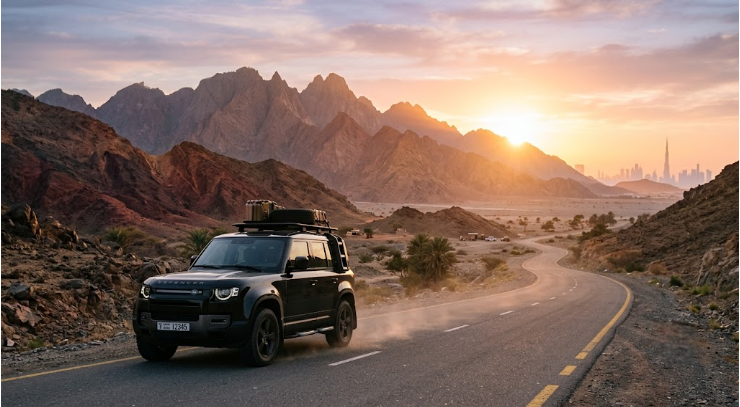
Dubai isn’t only towers and beaches. Drive an hour or two in almost any direction and you’ll find mountain roads, quiet coastline and a lot of empty desert. If that sounds like your kind of trip, a Land Rover rental in Dubai gets you a Defender with room for passengers and bags.
Before you pick a car, though, it helps to know what the trip involves: which routes are worth the drive, what the rental desk will ask for, and which costs tend to turn up after you’ve handed the keys back. The details below are current as of October 2026. Rules and prices do change, so I’d still check u.ae, the RTA and Parkin for anything that matters to your dates.
Which Routes Are Worth Driving
Decide where you’re headed before you choose a car. The distances below are ballpark figures, and a bad traffic day can add 30 minutes or more.
Hatta and the Hajar Mountains
Hatta is about 130 km from Dubai, right by the Omani border. It’s mostly about the mountain scenery and the dam, and it works nicely as a half-day trip.
Abu Dhabi in a Day
Abu Dhabi sits about 140 km down the main highway. Sightseers usually aim for the Sheikh Zayed Grand Mosque or the Louvre Abu Dhabi. Tolls work differently there too, since the emirate has its own system, Darb, which comes on top of Dubai’s Salik.
Ras Al Khaimah and Jebel Jais
Jebel Jais is the highest mountain in the UAE, and getting there from Dubai takes around an hour and a half depending on where you start. The road winds a lot and it’s noticeably cooler at the top, so fill the tank before you start climbing.
The East Coast
If you’d rather see the Gulf of Oman, Fujairah and Khor Fakkan are about two hours each way, through the Hajar Mountains. That’s a long day, so leave early.
Honestly, I’d stick to one destination per day. It looks doable on a map, but you’ll end up spending most of it driving.
Licence Rules for Visitors
The first thing a rental desk will ask for is your licence, so it’s worth getting this right before you fly. The UAE recognises licences from a list of countries for short visits. If your country isn’t on the list, you’ll need an International Driving Permit (IDP) to carry with your original licence. Some rental companies also ask for an IDP even when your home licence is accepted, because it’s part of their own policy. That means the company’s rules matter as much as the country list.
An IDP isn’t valid on its own, only together with your original licence, and it has to be issued in the country that issued your licence, so you can’t pick one up after you arrive. The current list of recognised countries is on u.ae and the RTA website.
Minimum age is set by each company rather than by law, and it’s usually higher than the legal driving age. Performance and luxury cars can push it up again.
Insurance on a Long Drive
The more kilometres you cover, the more likely a stray stone is to chip the windscreen, so it’s worth reading the policy more carefully than you would for a short city rental. The number to look for is the excess, which is the amount you pay if the car gets damaged.
Then check what’s left out. Glass, tyres, the underside and the interior are sometimes excluded from standard cover. Where a company sells more than one insurance plan, find out what separates them.
Extra cover shrinks what you’d pay out of pocket. Weigh its daily cost against the excess it removes, and decide if it’s worth it. Before you drive off, take photos of the car from every angle, including the wheels and windscreen, and do the same on return.
Deposits and “No Deposit” Offers
Most rental companies take a deposit on a credit card to cover fines, tolls and any damage. It’s a hold rather than a charge, but it reduces your available credit, and it can take a few days to be released after you return the car. So don’t rely on that credit for your hotel bill.
Offers for luxury car rental Dubai – no deposit are all over the internet, and some companies genuinely work that way. VIP Transits, for example, says on its website that it doesn’t require a security deposit, though you should check the current terms before you book. Others still take a deposit, or link a lower one to extra insurance or a higher daily price. Whatever you agree on, get it in writing, along with the date any hold is released.
Costs That Show Up Later
Road trips tend to collect small charges. Dubai’s Salik tolls have no booths, because gates read a tag on the windscreen as you pass. Published rates have run from AED 4 to AED 6 per crossing depending on the time of day, and the rental company usually bills you afterwards, sometimes adding a small fee. Abu Dhabi’s Darb is a separate system, and as of this writing the northern emirates don’t have toll systems.
Fines are issued to the car’s registered owner, so the rental company pays them and passes the cost on to you, normally with an admin fee. That bill can easily arrive after you’ve gone home.
Most companies expect the car back with the same amount of fuel you started with, and a late return can be charged as a whole extra day. Some also charge for hotel delivery, while others don’t, so ask about it up front.
Road Rules and Parking
Cameras cover most of the major roads, so it’s safest to assume you’re on one. Speed limits change between roads and between emirates, which means the posted sign matters more than whatever limit you last remembered. Drinking and driving isn’t tolerated at all, handheld phone use is penalised, everyone needs a seat belt, and children have their own rules, so arrange a child seat before you collect the car.
Parking in Dubai is mostly paid and run through Parkin. It charges roughly AED 2 to AED 6 an hour, based on the zone and the time of day. Plenty of street zones are free on Sundays and public holidays, though not every one, so check the sign before you walk off. Pavement parking is a bad idea: published fines for blocking pedestrians are about AED 400. Parkin’s website has the current rates.
Choosing the Right Car
Why an SUV Makes Sense Here
For mountain roads, long highway stretches and a boot full of luggage, an SUV is hard to beat. VIP Transits’ Land Rover page lists the Land Rover Defender 2025, for example, with a 3.0-litre turbo mild-hybrid engine and a 0–100 km/h time of 6.1 seconds. It’s listed from AED 920 a day at the time of writing, with delivery anywhere in Dubai, though you should check the current rate and terms before building a budget around them.
Expect tighter conditions on luxury cars. The excess may be bigger, and some companies set a higher minimum age or ask for more driving experience. The mileage allowance is what catches road-trippers out. Unlimited-mileage plans exist with some providers, while others set a daily cap, and a Hatta day followed by an Abu Dhabi day can burn through it fast.
What to Ask Before You Book
A couple with cabin bags can get by in something smaller. Four people with suitcases can’t. Ask how breakdowns on the road are handled, and whether the car can be delivered to your hotel or the airport, so the trip starts the moment you land.
Frequently Asked Questions
Can I take a rental car to Oman?
Not automatically. Crossing a border normally needs written permission from the rental company and the right insurance, so sort it out before you plan the trip.
Can I drive an SUV off-road in the desert?
Check the contract first. Many rental agreements restrict off-road driving, and damage from it may not be covered. For dune driving, a guided desert tour is usually the safer option.
Can someone else drive part of the way?
Yes, as long as they’re added to the agreement and meet the same age, licence and document requirements as you.
What should I do if the car breaks down or I’m in an accident?
Call the rental company first. If there’s been an accident, follow the police’s instructions, as insurance claims usually depend on an official report.
Is summer a good time for a road trip?
It can work, but temperatures often pass 40°C, so keep water in the car and skip long outdoor stops at midday. Save mountain drives and sightseeing for the morning or evening.
Your Next Step
Pick two or three stops rather than six. Then check your licence and IDP, ask about the excess, and find out how tolls and fines will be billed. Once you know what the trip looks like, you can compare cars for your dates, and if you’d like a place to start, luxury car rental Dubai – no deposit options are available with VIP Transits. Check the current terms before you book.
 admin