
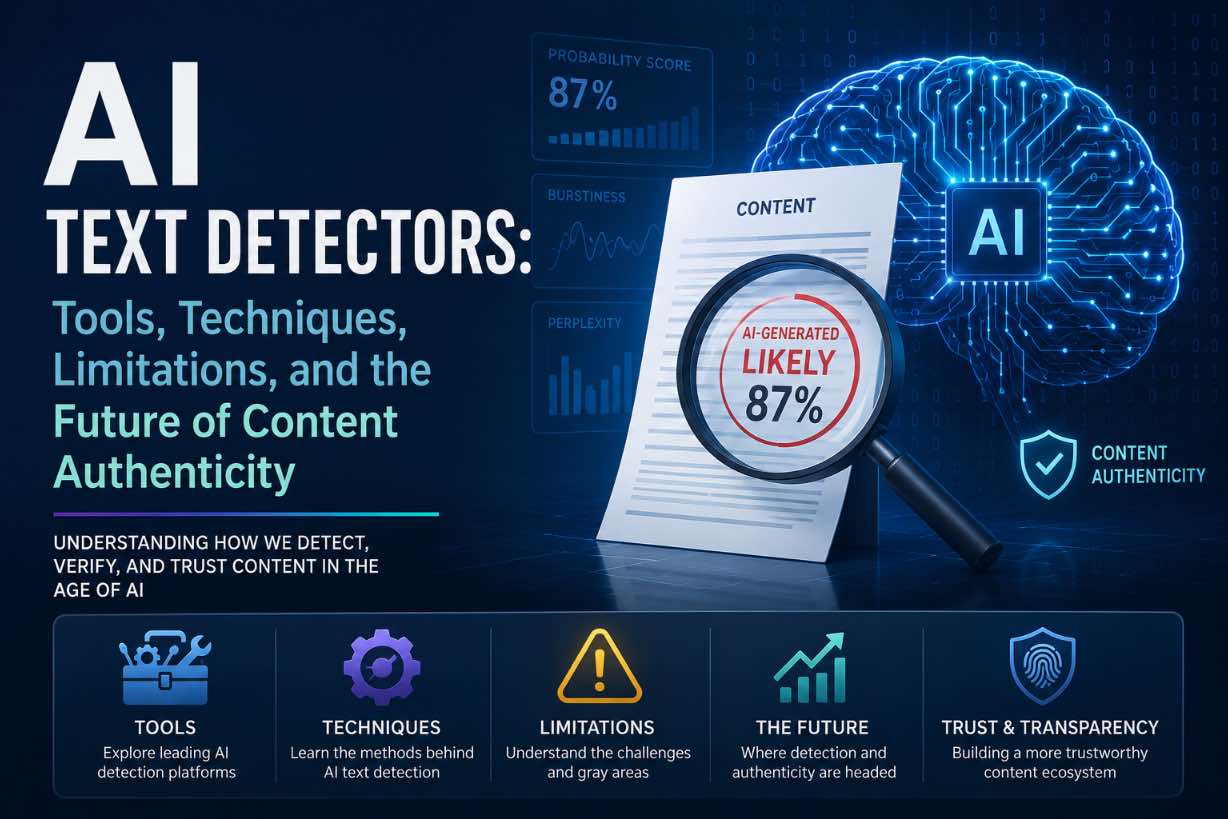
In an era where tools like ChatGPT, Claude, Gemini, and Grok can generate coherent, human-like text in seconds, distinguishing between human-written and AI-generated content has become a pressing need. AI text detector (also called AI content detectors or AI checkers) are software tools designed to analyze writing and estimate the probability that it was produced or heavily assisted by artificial intelligence.
These detectors are now widely used in education, journalism, publishing, marketing, and recruitment to maintain originality, combat misinformation, and uphold academic integrity.
How Do AI Text Detectors Work?
AI detectors do not “know” the origin of text with certainty. Instead, they use probabilistic analysis based on patterns that differ between typical human and AI writing.
Key techniques include:
- Perplexity: Measures how predictable the next word in a sequence is. AI models tend to choose highly probable words, resulting in lower perplexity (smoother, more “average” text). Human writing is often more surprising or varied.
- Burstiness: Refers to variation in sentence length, complexity, and structure. Human writing tends to have more “bursts” of short and long sentences, while AI output can be more uniform.
- Linguistic and statistical patterns: Detectors analyze word choice, repetition, syntax, discourse markers, paragraph coherence, and other stylistic features. They often use machine learning classifiers trained on large datasets of both human and AI-generated text.
- Advanced models: Some tools employ transformer-based models (similar to those powering LLMs) fine-tuned specifically for detection, or multi-layer systems that cross-check signals.
Many also integrate plagiarism checking and, in some cases, support for images or other media.
Popular AI Text Detectors in 2026
Several tools stand out based on recent tests and reviews:
- GPTZero: Frequently praised for high accuracy (claimed ~99% in some benchmarks), low false positives, and features like “mixed” content detection. Popular in education.
- Copyleaks: Often ranks among the top for overall accuracy, with strong performance across languages and formats, and a low false positive rate. Used by enterprises and institutions.
- Originality.ai: Strong in content creation and SEO contexts, with good detection of edited or hybrid text.
- QuillBot, Winston AI, ZeroGPT, and Turnitin: These offer various strengths—QuillBot includes humanizing features, Winston supports OCR/handwritten text, and Turnitin is entrenched in academia.
Free tiers exist for many, but premium versions provide deeper analysis, batch processing, and API access. Performance varies by tool, text length, and domain—longer texts are generally easier to evaluate reliably.
Accuracy and Limitations
Modern detectors perform well on raw, unedited AI text—often exceeding 90% accuracy in controlled tests. However, real-world reliability is lower:
- Editing and paraphrasing drastically reduce detection rates. Minor human tweaks, “humanizer” tools, or prompts like “write like a teenager” can fool many detectors.
- False positives: Human-written text, especially by non-native English speakers, neurodivergent writers, or those with formal/academic styles, can be flagged as AI. Studies highlight bias risks against ESL students.
- False negatives: Sophisticated AI or hybrid (AI + human) content often slips through.
- Experts and studies emphasize that detectors are probabilistic tools, not definitive judges. They should support, not replace, human review. OpenAI even discontinued its own detector due to poor performance.
Accuracy improves with context (e.g., comparing to a writer’s previous work) but remains an imperfect science in an ongoing “arms race” with advancing generative models.
Applications and Ethical Considerations
Common uses:
- Educators checking student submissions.
- Publishers and platforms verifying content originality.
- Businesses ensuring brand voice and quality.
- Fact-checkers combating AI-generated misinformation.
Challenges:
- Over-reliance can lead to unfair accusations and chilled creativity.
- Privacy concerns with uploaded texts.
- Potential for bias and discrimination.
- Philosophical questions: If AI assists but a human edits heavily, is it “AI content”?
Institutions are shifting toward policies that encourage responsible AI use rather than outright bans, combined with process-based assessments (e.g., drafts, reflections).
The Future: Watermarking and Beyond
A promising development is watermarking—embedding invisible statistical signals or patterns into AI-generated text during creation. Major companies are exploring or implementing this, making detection more reliable for compliant models.
However, watermarks can be removed or evaded, and open-source models may not include them. Future detectors will likely combine statistical analysis, watermark detection, behavioral signals (e.g., writing history), and multi-modal checks.
As generative AI improves, perfect detection may become impossible. The focus is shifting toward transparency, provenance tools, and hybrid human-AI workflows.
Conclusion
AI text detectors are valuable aids in navigating the blurred line between human and machine writing, but they are not infallible. The best approach combines technology with critical thinking, context, and clear policies. As AI becomes ubiquitous, the real solution may lie less in detection and more in embracing ethical collaboration between humans and machines—while valuing authentic human creativity.
Whether you’re a teacher, writer, editor, or curious user, understanding these tools helps foster responsible AI use in a world where text generation is easier than ever. Stay informed, test multiple detectors when stakes are high, and remember: the goal is better content, not perfect policing.